








What’s In My Phone? Using Chemistry to Explain Technology and How to Stay Safe Using it
By Stephanie Keyser, Chemistry and AP Environmental Science Teacher and 2024-25 Xplorlabs Educator Fellow, Marietta, Georgia
Learning about the technology that powers cellphones
Students became completely engaged in learning about the periodic table once I shared that several elements are essential to the technology that powers their phones — the lithium-ion battery. In order to hook students, I used an EpiPen training device with voice commands that are powered by a lithium-ion battery. Then, we discussed what other things may use lithium-ion batteries and attempted to estimate how many lithium-ion batteries exist in the school.
Some products were surprising, like our badges that alert law enforcement and administrators if activated, in addition to ones we all use everyday like cellphones, watches, and listening devices. Through inquiry-based questioning, students explored the difference between metals and nonmetals, interactions of metals and nonmetals, and possible alternatives to the lithium-ion battery all while learning about the periodic table.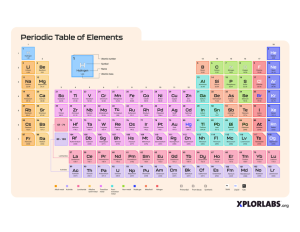
Students used a gallery walk to explore different metals and their characteristics. This tangible exploration allowed students the opportunity to make sense of the way the periodic table is arranged. They also learned where metals were mined and the destruction that may have on the environment. Students visited the Tellus Science Museum in Cartersville, Georgia, to see what different metals can be found in our state. Students also learned about mitigation of natural resources and reclamation of the land, possible recycling methods, and where to take used batteries.
During the exploration of metals and nonmetals, we kept returning to the lithium-ion battery, and in the next unit, we learned how ionic compounds were named. The students were taught that ionic compounds have a metal and nonmetal component which helped them make sense of what other materials are needed to complete a battery. Students were asked to solve a problem of finding a possible alternative to the lithium-ion battery if there are other readily available sources.
The widely used lithium-ion battery was a connection my students were able to make to their daily lives. I noticed the increased use of scientific vocabulary and overall engagement through learning about the periodic table and naming of compounds. Assessment scores increased in comparison to previous years, and I credit some of this to bringing real-world phenomena to the classroom.
Thermal energy and safety of lithium-ion batteries
In addition to learning how and why a lithium-ion battery works, I also introduced the safety of using a lithium-ion battery while teaching a thermodynamics unit. Although students had heard about the dangers of batteries, we were able to further explore why thermal runaway occurs as we learned more about how heat travels as energy transfer. We used Xplorlabs to investigate thermal runaway and the causes. Students were able to take away safety precautions while using the many products powered by batteries. I had never thought to bring the safety science of everyday life into the classroom, but this pathway was a perfect way to get students exploring ways to keep themselves safe in their environment.
While learning about the phenomena of thermal runaway and fire, students explored what actually burns (gas) and the phase changes that all matter undergoes while exposed to extreme heat.
Pedagogical strategies to use across all curriculums
Lastly, it was such a unique experience to work with other educator fellows from around the country, across different subjects, and in diverse teaching environments. Having input and discussions from multiple viewpoints gave me a lot of perspective on how my students and colleagues think. The different pedagogical methods I found most useful were the gallery walks, authentic realworld explorations, and the different protocols that the facilitators put in place for us to use while discussing experiences.
I was able to make connections for my students, and they were able to learn content and comfortably use scientific vocabulary because we kept using it daily. They were also able to relate these lessons to things they already knew, so the learning did not feel like such a stretch for them. Students explored taking action within their own homes and communities by making safety posters and helping their families correctly dispose of lithium-ion batteries.