







Engaging and Empowering Youth Through Safety Science and Sustainability Learning
By Luis Fregoso Arias, Salud en Balance Community Center Educator and 2025-26 Xplorlabs Educator Fellow, Phoenix, Arizona
As educators, we often discuss engagement and empowerment in the classroom, but what does that really mean? As an informal educator, I am frequently considering these things in order to develop my approach to teaching. By participating in the Xplorlabs Educator Fellowship, I’ve come to realize that engagement and empowerment can mean many things but have something critical in common: engaged and empowered learners don’t merely absorb information. Rather, they actively shape their own learning — and my students did just that when learning about safety science and sustainability this school year.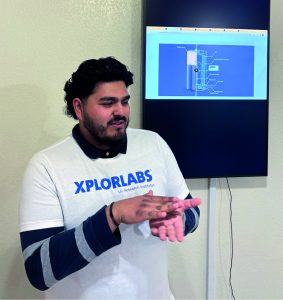
Learning and teaching students about lithium-ion batteries
My elementary-age learners from the Salud en Balance Youth in Action program embarked on a journey with me this year, exploring lithium-ion batteries (LIBs) with the help of Xplorlabs’ resources. I knew I wanted to focus on a topic that would speak directly to each student’s everyday experiences, and these batteries are an incredibly common but often overlooked component of daily life. We began simply — activating students’ prior knowledge and having discussions around questions like, “Where do you see batteries in your daily life?” and “What do you know about safely using and disposing of batteries?”
We deepened our exploration using Xplorlabs’ virtual cityscape resource. This tool allowed students to visually recognize just how pervasive lithium-ion batteries are in their communities — they are in phones and laptops, and even our solar- powered garden station at school.
Discussions grew more profound as students began to recognize not only the benefits of these devices, but also their hidden dangers, such as thermal runaway and environmental contamination due to improper disposal.
We began connecting this foundational knowledge to the real world, starting with safety scenarios that young children would readily understand, such as damaging LIB devices through rough play. We then expanded our discussion to include larger issues, such as how improper electronic disposal, or e-waste, affects local environments like our community garden. Students were surprised and concerned when we linked improper battery disposal to issues such as soil contamination and biodiversity loss — issues that can directly impact the health and sustainability of their communities. It was remarkable to observe them genuinely engage in this content and transition into advocates for their families and communities.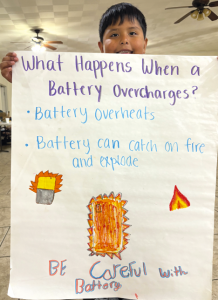
Student engagement and empowerment: insights from the fellowship
Prior to participating in the Xplorlabs Educator Fellowship, I approached teaching in a more traditional way. I was taught that an educator’s job is to lead, inform, and more often than not, provide clear answers to students. I was also taught that if students approach learning in a particular way, they will retain information and be successful.
While this can be true, the fellowship has opened my eyes to successfully teaching in different ways, such as action-oriented pedagogy. With some of my students being as young as 6 years old, my first reaction was uncertainty — how would my students react to having more responsibility? Could I trust them to make choices in this way?
One of my biggest “aha” moments this school year was realizing that children can — and should — take active roles in their learning, guiding some of their own inquiry rather than simply following directions. Not only was this the biggest perspective shift that I experienced as an Xplorlabs Educator Fellow, it was also the most rewarding. It was amazing seeing the participants work together to translate their new awareness of lithium-ion battery issues into tangible action.
Using Xplorlabs’ resources, the children created their own safety posters to educate their community members about proper battery use and safe disposal methods. They even designed simple but impactful pamphlets about how to safely operate our community center’s photovoltaic garden power stations, demonstrating their understanding of battery technology and their growing commitment to community safety.
Looking ahead: beyond the classroom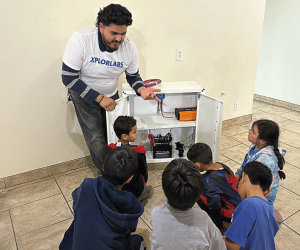
In the future, I envision children in the YLA program continuing to engage deeply with safety science and sustainability issues, seeing themselves not only as learners but also as community leaders. Already their enthusiasm has rippled outward, influencing their families’ practices around safe battery use and disposal. I am excited to see what they do next.
If you are considering incorporating safety science and sustainability into your classroom, I wholeheartedly recommend that you embrace student agency in the process. You can start small: invite students to identify an issue that they care about in their community. Then, use safety science concepts to explore potential solutions. You may be surprised, as I was, by the insights and motivation that even your youngest learners bring to the table.