








Saving the World — One Battery at a Time
By Marc Cohen
6th Grade Science Teacher, Science Lead/Testing Coordinator, STEM/Coding Club Coordinator
Philadelphia, Pennsylvania
When I first joined the Xplorlabs Educator Fellowship, I was excited — but also curious. Like many educators, I’m always searching for ways to make science feel meaningful and relevant for my students. The fellowship promised hands-on exploration and real-world STEM connections. What I didn’t fully anticipate was how much those experiences would transform not only my classroom, but also how my students saw science in their everyday lives.
Making connections
One of the most memorable parts of this journey was watching students shift from passive learners to active problem-solvers.
When we began exploring lithium-ion batteries and energy storage, the topic initially seemed familiar but distant. Students use lithium-ion batteries every day — in phones, laptops, gaming systems, and increasingly, electric vehicles — but most had never thought about what actually makes them work. That changed quickly.
As we began investigating how batteries store and transfer energy, the energy in the classroom shifted as well. Instead of just listening, students were experimenting, observing, and asking questions. They tested materials, discussed ideas with their classmates, and began thinking more deeply about the science behind everyday technology. One moment that stuck with me happened during a hands-on investigation exploring conductivity and energy flow. After watching the experiment footage from ULRI’s Fire Safety Research Institute, a student paused, looked at the materials in front of them, and said, “Wait, the materials we choose determine whether the energy can move?”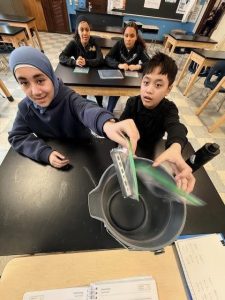
They were getting it! That was when students realized that cellphones, because of their lithium-ion battery, can experience thermal runaway, as well as the risk they were taking by sleeping with their phones on their pillow. None of them do that anymore.
That realization — connecting a concept to something tangible — is exactly why hands-on science experiences matter.
The next step
As we continued exploring battery technology, our conversations expanded beyond how batteries work to why they matter. Students quickly realized that lithium-ion batteries play a key role in solving some of the biggest challenges facing our world today. Renewable energy systems rely on battery storage. Electric vehicles depend on advances in battery design. Even portable medical devices require reliable battery technology.
One of the most meaningful discussions came when we began talking about what happens to batteries after we use them. Lithium-ion batteries power many of the devices students rely on every day, but they don’t last forever. That led us to explore an important question: What should happen to batteries when they stop working?
This conversation turned into a classroom investigation about battery recycling and sustainability. Students examined different battery types and researched the materials found inside lithium-ion batteries — elements like lithium, cobalt, nickel, and copper. They were surprised to learn how valuable these materials are and how much energy and effort it takes to mine them.
To help students think more critically about the issue, we conducted a small investigation comparing the environmental impact of producing new battery materials with the benefits of recovering those materials through recycling. Students analyzed information, discussed trade-offs, and brainstormed ways communities could improve battery recycling efforts. The conversations that followed were some of the most thoughtful discussions we had all year. One student asked, “If we can reuse materials from old batteries, why aren’t we recycling all of them?” Another student pointed out that many people probably throw batteries away simply because they don’t know where to recycle them. That observation opened the door to a discussion about awareness and responsibility.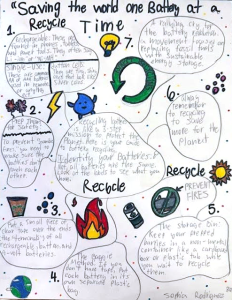
Students were also surprised to learn that improperly disposed lithium-ion batteries can cause safety hazards. When crushed or damaged in waste systems, they can experience thermal runaway, potentially igniting and causing fires in garbage trucks or recycling facilities. For many students, this was the moment when recycling became more than just an environmental slogan, they began to see it as part of a larger system — one that connects STEM, natural resources, and sustainability. Students were compelled to lead a battery recycling initiative in our school and community — collecting and recycling more than 300 batteries.
Teacher fellowship = student impact
Throughout the fellowship experience, I was reminded how powerful hands-on exploration can be. When students manipulate materials, test ideas, and analyze results, science becomes something they experience rather than memorize. Curiosity takes over, and learning becomes much more meaningful. I also saw collaboration grow in the classroom. Students shared ideas, debated solutions, and helped one another interpret results. Some students who were usually quiet became leaders during investigations, while others discovered strengths in explaining concepts or organizing data. Reflecting on this experience, one thing stands out clearly: When students see how science connects to real-world challenges, their perspective changes. They begin to see themselves not just as students learning science, but as potential contributors to solving real problems. For educators considering opportunities like the Xplorlabs Educator Fellowship, my advice is simple: make room for curiosity and real-world discovery. Give students the freedom to ask questions, explore ideas, and connect their learning beyond the classroom walls.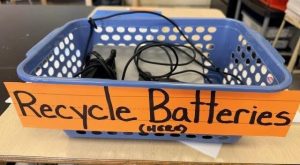
Some of the most powerful moments in my classroom didn’t come from a textbook. They came from students asking thoughtful questions and working together to find answers.
During one project, our principal stepped in and was struck by what she saw — students fully engaged, the classroom buzzing with activity, and piles of batteries, tape, and plastic collected for recycling. She saw it not as chaos, but as something incredible: a student-driven effort that connected the school to the community in a meaningful way. Saving the world may sound like an enormous goal. But sometimes it starts with something small — students learning how a battery works, asking what happens when it stops working, and realizing they can be part of building better solutions. One question, one experiment, and one recycled battery at a time.